What pays off for your company?
In practice, the decision as to whether calves should be fed with whole milk or milk replacer (MAT) is less a question of conviction than of economic considerations.
Milk price, drinking quantity, labor management and animal health have a decisive influence on which system is profitable under the respective conditions.
We therefore show below which system pays off and when, and what the respective advantages and disadvantages are.

What pays off for your company?
In practice, the decision as to whether calves should be fed with whole milk or milk replacer (MAT) is less a question of conviction than of economic considerations.
Milk price, drinking quantity, labor management and animal health have a decisive influence on which system is profitable under the respective conditions.
We therefore show below which system pays off and when, and what the respective advantages and disadvantages are.
Milk replacer - calculable and management-friendly
Above all, milk replacers offer safety. High-quality products with a high milk protein content enable very good daily weight gains when used correctly.
Pros: consistent and high-quality composition, very high digestibility, clear costs per calf, high hygiene safety, easy to automate
Contra: correct mixing is absolutely essential
Whole milk - fluctuating ingredients, hidden costs
Whole milk is considered the nutritional reference feed for pre-ruminant calves.
Pro: good acceptance, no mixing errors, physiologically natural
Cons: Fluctuating ingredients, hygiene risks (germs, mastitis or antibiotic milk), additional work and energy required, supplement must be mixed in
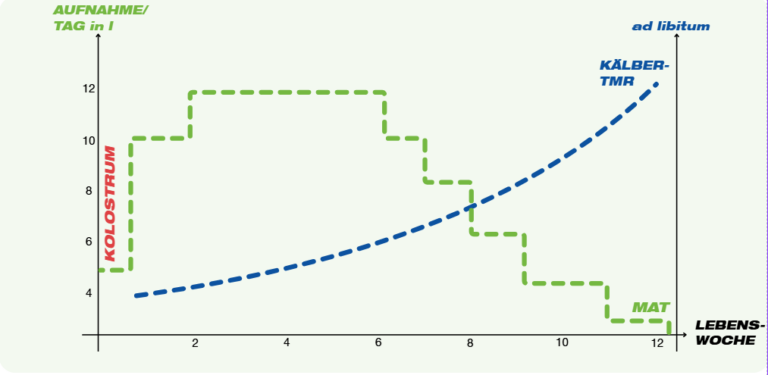
This feeding plan enables calves to be ideally fed from the colostrum phase to weaning. A needs-based milk quantity in combination with early TMR intake promotes health and development. The dynamic transition ensures stability and low-stress weaning.
Profitability calculator
Cost of milk replacer vs. whole milkCalculation basis: 12-week feeding period.
Metabolic programming
The first few weeks of life are the crucial phase in which important systems and organs develop.
This also affects the animals' subsequent metabolism and performance.
Metabolic programming
The first few weeks of life are the crucial phase in which important systems and organs develop. This also affects the animals' subsequent metabolism and performance.
Before birth
- The mother cow’s diet shapes the calf’s metabolism while it is still in the womb.
- The nutrient supply influences later growth, energy utilization and performance
- Undersupply leads to programming to a “deficiency mode”.
- Later intensive feeding increases the risk of metabolic problems and lower feed efficiency.
- Feeding suckler cows according to their needs is crucial for healthy, productive calves.
After the birth
- Postnatal feeding shapes the later performance of the dairy cow
- The early supply of nutrients influences growth, metabolism and energy utilization.
- A lack of energy leads to permanently lower feed intake and slower growth.
- Oversupply encourages rapid weight gain and later obesity.
- Long-term adaptations in the hypothalamus show the sustainable programming of hunger and satiety regulation as well as health and performance.
Before birth
- The mother cow’s diet shapes the calf’s metabolism while it is still in the womb.
- The nutrient supply influences later growth, energy utilization and performance
- Undersupply leads to programming to a “deficiency mode”.
- Later intensive feeding increases the risk of metabolic problems and lower feed efficiency.
- Feeding suckler cows according to their needs is crucial for healthy, productive calves.
After the birth
- Postnatal feeding shapes the later performance of the dairy cow
- The early supply of nutrients influences growth, metabolism and energy utilization.
- A lack of energy leads to permanently lower feed intake and slower growth.
- Oversupply encourages rapid weight gain and later obesity.
- Long-term adaptations in the hypothalamus show the sustainable programming of hunger and satiety regulation as well as health and performance.
We have explained in videos how to mix, dose and feed the milk replacer correctly. Simply watch them here and learn more:
Would you like to optimize your calf feeding or do you have specific questions? Contact our advisors, we will be happy to support you personally.
We have explained in videos how to mix, dose and feed the milk replacer correctly. Simply watch them here and learn more:
You are currently viewing a placeholder content from YouTube. To access the actual content, click the button below. Please note that doing so will share data with third-party providers.
More InformationWould you like to optimize your calf feeding or do you have specific questions? Contact our advisors, we will be happy to support you personally.